US authorities say Barclays "intentionally misrepresented" key facts about securities sold to investors from 2005 to 2007, and the bank has agreed to pay a large fine to resolve the fraud case (AFP Photo/Tolga AKMEN)
Washington
(AFP) - British banking giant Barclays has agreed to pay a $2 billion fine to
resolve a fraud case involving mortgage derivatives sold in the run-up to the
2008 global financial crisis, the US Justice Department said Thursday.
Authorities
said the loans underlying the investment vehicles "were significantly less
creditworthy than Barclays represented," and the company
"intentionally misrepresented" key facts about the mortgages
involved.
Federal
prosecutors also reached settlements with two former Barclays executives over
their roles in the sale and trading of residential mortgage-backed securities
(RMBS), a type of investment derivative that bundled home loans into securities
sold to investors.
Paul
Menefee of Austin, Texas, the former head banker for subprime RMBS
securitizations at Barclays, and John Carroll of Port Washington, New York,
former head trader for subprime loan acquisitions, will pay a combined total of
$2 million.
The
settlement made Barclays the latest major bank to be sanctioned for crisis-era
fraud nearly a decade after the collapse of major New York financial
institutions dealing in mortgage-backed derivatives sparked a global recession.
Last week,
Swiss bank UBS agreed to pay $230 million to New York state, also settling
charges the bank had misrepresented the value of mortgages underlying
securities sold before the crisis.
After a
three-year investigation, federal prosecutors accused Barclays of a fraudulent
scheme involving 36 deals in RMBS initially valued at $31 billion.
Barclays
misled investors about the assets' quality, causing billions of dollars in
losses, the Justice Department said in a statement.
The bank
lied about the creditworthiness of borrowers whose loans underpinned the
securities and who then defaulted at "exceptionally high rates," the
statement said.
In exchange
for paying the fine, the Justice Department will withdraw a civil complaint
filed against the Barclays in December 2016.
Facing the axe: Australia coach Darren Lehmann (left) and Steve Smith
The axe was
hanging over the head of Australian coach Darren Lehmann and skipper Steve
Smith Tuesday with cricket chiefs holding crisis talks in South Africa to deal
with an escalating cheating scandal.
Cricket
Australia (CA) boss James Sutherland, under mounting pressure to come down hard
on what Australian media has dubbed a "rotten" team culture, was due
in Johannesburg Tuesday where he will meet up with the body's head of integrity,
Iain Roy.
They are
expected to update a shocked Australian public on Wednesday morning, with
reports saying they could throw the book at Smith and his vice-captain David
Warner by banning both for 12 months and sending them home in disgrace.
Smith has
already been suspended for one Test and docked his entire match fee by the
International Cricket Council for his role in a plot that saw teammate Cameron
Bancroft tamper with the ball during the third Test against South Africa on
Saturday.
It means he
will miss the fourth and final Test in Johannesburg starting Friday.
Lehmann
silence
Lehmann has
remained silent since the furore, but Britain's Daily Telegraph said he had
decided to quit, effective immediately, meaning he too will play no part in the
Test.
Lehmann
took over the coaching reins in 2013 when predecessor Mickey Arthur was sacked,
with Justin Langer considered a frontrunner as his replacement although Ricky
Ponting will also be in the mix.
"We
are aiming to be in a position to fully update the Australian public on the
investigation and outcomes on Wednesday morning," Sutherland said in an
email to cricket fans.
"We
understand the strong interest everyone has in this situation and we are
following due process to properly address all of the relevant issues
involved."
Prime
Minister Malcolm Turnbull reiterated Tuesday that it had been "a shocking
affront to Australia" and Cricket Australia must act "decisively and
emphatically".
Former
Australian coach John Buchanan, who led the team from 1999 to 2007, said Smith
must resign as captain and urged cricket chiefs to be fully transparent in
their investigation.
"It is
a very difficult time for members of Australian cricket; however, I believe
there is a golden opportunity to reset the dial around player and staff
behaviours, actions and decision-making," he told reporters.
National
outcry
There has
been a national outcry over Smith's admission that the leadership group within
the team decided to cheat.
That group
of senior players usually includes fast bowlers Josh Hazlewood and Mitchell
Starc, but they are reportedly furious at being embroiled in the saga and may
contact the Australian Cricketers Association to enlist union support to clear
their names.
The
ramifications of the scandal have been far reaching with the Marylebone Cricket
Club, the guardian of the laws of the game, calling for a "major shift in
attitude" to preserve the game for future generations.
"The
behaviour of some of the players in the current South Africa/Australia series,
and other incidents in recent times in the game we all cherish, has fallen well
below the standard required to inspire future generations of cricket-loving
families," the MCC said.
While Smith
was removed from the Australian captaincy for the remainder of the third Test,
former South African captain Graeme Smith hit out at the ICC's handling of the
scandal.
Ashes
accusation
"I
think the ICC missed an opportunity to really handle this properly and lead our
game," he told South Africa's Independent Media.
"They
haven't done that. You have had two players, who have admitted guilt for
cheating. I think that's huge."
Bancroft
used a strip of yellow sticky tape he'd covered with dirt granules to illegally
scratch the rough side of the ball, thereby facilitating more swing for
bowlers.
He was
filmed not only rubbing the ball with the dirtied tape but concealing the
evidence down the front of his trousers. The ICC fined him 75 percent of his
match fee and slapped him with three demerit paints, but he escaped a
suspension.
Smith
insisted it was the first time his team had cheated in this manner, but former
England captain Michael Vaughan claimed he is "pretty sure" Australia
were ball-tampering during their 4-0 victory in the Ashes, which finished
earlier this year.
"I
look at the amount of tape some of the fielders have worn, particularly during
the Ashes series at mid-on and mid-off. You don't have to name names, they know
who they are," he told BBC Sport.
Cricket Australia hold crisis talks with captain Steve Smith likely to face further punishment over the ball-tampering scandal. Who could succeed Smith if he is stripped of the captaincy? 🏏🇦🇺 https://t.co/ORUr9v8LcVpic.twitter.com/DmpxPf8cD9
Gun reform advocates line Pennsylvania Avenue while attending the March for Our Lives rally March 24, 2018 in Washington, DC (AFP Photo/WIN MCNAMEE)
New York
(AFP) - The US gunmaker Remington filed for bankruptcy protection on Sunday, a
day after marchers swarmed US cities nationwide to call for greater regulation
of firearms.
But the
hard times now facing gun companies began in November 2016.
That was
when Donald Trump's surprise election victory in the US led to a sudden drop in
US firearms demand, which had been robust until then as gun owners stockpiled
in anticipation of a Hillary Clinton presidency.
With Trump
an avowed gun rights supporter with boasts of warm ties to the National Rifle
Association, in office, gun enthusiasts slowed purchases, causing a glut.
Massive discounting and deep layoffs at firearms companies soon followed.
Gunmakers
now face intensifying public scrutiny following the February 14 Florida school
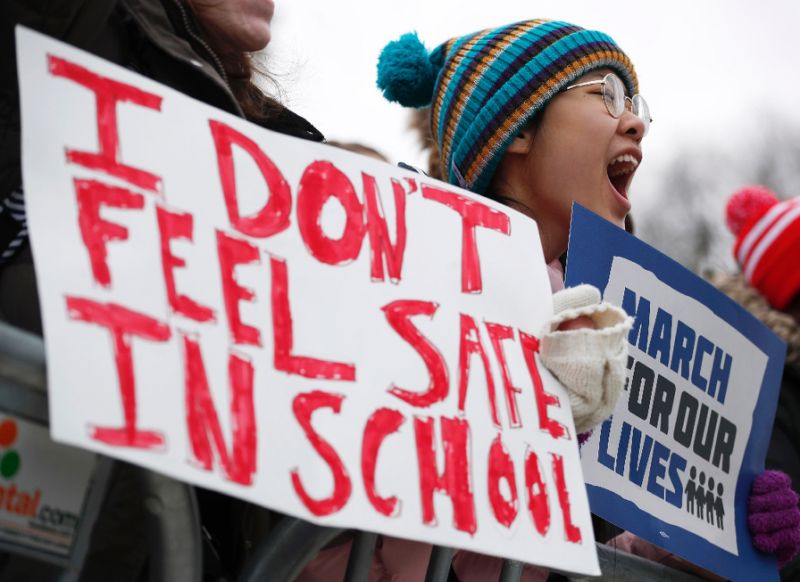
shooting that left 17 dead, sparking Saturday's "March for our
Lives."
Retailers
such as Dick's Sporting Goods and Walmart have moved to to distance themselves
from the extreme end of the political spectrum on gun rights -- with aversion
spreading to the financial sector as well.
But the
immediate problem facing Remington and other firearms companies is the
expectation for "new, lower levels of consumer firearm demand,"
American Outdoor Brands chief executive James Debney said earlier this month.
He said
"flattish" firearms sales could persist for another 12-18 months.
Headquartered
in North Carolina, Remington dates to 1816, making it one of the nation's
oldest gunmakers.
Besides
guns, it makes bullets and barrel equipment, employing 2,700 people at seven
facilities in the US and exporting to 52 countries, chief financial officer
Stephen Jackson said in a filing in US Bankruptcy Court in Delaware.
Remington
experienced a "significant decline in sales" over the last year when
demand "ultimately did not materialize" after the company boosted
output in 2016, Jackson said.
Operating
profits in 2017 dwindled to just $33.6 million, less than one third the level
just two years earlier, Jackson said.
Some
financers say no
On February
12, two days before the Parkland shooting, Remington signaled plans to file for
bankruptcy protection, saying it reached a preliminary agreement with its
creditors to allow the company to operate while it reorganizes.
Protestors
chant during the March for Our Lives rally on March 24, 2018 in
Chicago, Illinois
(AFP Photo/JIM YOUNG)
Remington
however encountered difficulty with efforts to expand its pool of financers for
the period after the bankruptcy filing, according to Ari Lefkovits, managing
partner of Lazard Freres, which was hired by Remington.
"Lazard
approached over 30 potential funding sources to provide such financing,"
Lefkovitz said. "The vast majority of lenders contacted, however,
indicated that they were reluctant to provide financing to firearms
manufacturers."
Remington
instead turned to its existing lenders, including JPMorgan Chase and Franklin
Advisers, Lefkovits said. Several others with long relationships with
Remington, including Bank of America and Wells Fargo, are also providing
financing during the propcess.
The
reorganization, considered a "prepackaged" bankruptcy because the
major parties have already reached agreement, would eliminate $775 million in
debt and shift to creditors control of new equity.
Besides the
financial incentive to stay in the transaction, banks involved in the
bankruptcy might face legal liabilities if they walked away now.
Bank of
America and JPMorgan declined to comment. Wells Fargo did not immediately
respond to request for comment.
The
bankruptcy comes amid intensifying pressure on major companies to take a stand
on guns.
Last week,
Citigroup became the first major US bank to unveil significant new policies on
guns, announcing it would require retail clients to bar sales to those under 21
or to people who have not passed a background check.
Citigroup
said it would also start "due diligence" among its gun manufacturing
clients to understand their operations and whether they are in line with
"common sense" gun policy.
Asset
manager BlackRock, the largest shareholder in several leading gun stocks, has
also signaled plans to intensify scrutiny.
It said in
a March 2 notice that it was taking steps to reach out to clients who do not
want to hold gun stocks and stepping up engagement with firearms executives on
their products.
Brewing giant Heineken has
pledged to do more to protect its sales agents in Africa after NRC published
allegations of widespread sexual abuse in 10 countries where it operates.
Around 2,000 women work for the Amsterdam-based multinational firm as ‘promotional
girls’ on the continent as part of a global sales force numbering 15,000 women,
according to internal research carried out in 2007.
Their work involves going
round bars, cafes and restaurants with promotional crates to persuade owners to
stock Heineken brands. NRC said many of the recruiters were sexually assaulted
or propositioned by cafe staff in the course of their work. In some cases
prostitutes combined beer promotion with their regular work to win new clients
for both themselves and the brewery.
One Nigerian-based promoter, named as
Sylvia by the newspaper, said the sales teams were warned not to make a fuss
about unwanted sexual advances. ‘They warned us that we would come across men
with bad intentions. You have to tolerate it because you want to make more
sales and strengthen the brand.’
Her colleague, named as Peace, said she
encountered unwanted sexual attention on a nightly basis. ‘It’s a public place
so it doesn’t get as far as rape. That only happens if the girls go with the
clients, but that’s their choice. Our employer says: if you can’t stand being
touched, go and find another job.’
Outsourced
Heineken said it was difficult to
monitor the work because most of it was outsourced, but pledged to step up its
efforts to cut out abuse of its agents. ‘The practices described are totally at
odds with what we stand for as a company and we condemn these abuses in the
strongest terms,’ the company said in a statement.
‘This subject deserves more
attention in Africa than it has received in recent years from us and other
interested parties. Together with our local workers’ councils, promotional
agencies and other relevant parties we will take further steps to tackle these
abuses and prevent them happening in future.’
Sylvia and Peace were not directly
employed by Nigerian Breweries, Heineken’s subsidiary in Lagos, but via an
agency that was hired through another subcontractor, making the chain of
command unclear. On average they were paid the equivalent of €7 for a night’s
work.
They estimated that around half their colleagues earned extra money
through sexual services. ‘Those girls couldn’t live on their wages and were
desperate. Sex earned more,’ said Peace.
‘High risk’
Emeka Dumbili, of the
Alcohol and Drugs Research Institute in Benin City, told NRC Heineken was still
recruiting young women in Nigerian provincial cities in order to use their
bodies to sell the company’s products. ‘It’s a marketing strategy to sell beer:
it reinforces drinking beer as a masculine, heterosexual activity.’
Heineken carried
out an internal study in 2007 which led to 70 markets being labelled ‘high
risk’ for women working to sell their brands, but the findings prompted too few
active measures, former personnel staff member Katinka van Cranenburgh told
NRC.
She said: ‘A few improvements were probably made in some countries, but
head office has taken a hands-off approach and isn’t on top of the situation. I
noticed that the guidelines are no longer online with other company policies,
as if it’s no longer an issue.’
Marjory Stoneman Douglas High School student Emma Gonzalez (C) gathers with other students on stage during the March for Our Lives rally (AFP Photo/ Nicholas Kamm)
Washington
(AFP) - Student organizers of gun control rallies that drew hundreds of
thousands to US streets vowed Sunday there will be no letup in their campaign
for reform.
The
nationwide protests on Saturday were by far the largest in nearly two decades,
part of a reignited gun control debate sparked by last month's killings at a
Florida high school.
"This
is not the end. This is just the beginning," Emma Gonzalez, a leader of
the movement, said on CBS's "Face the Nation."
Gonzalez,
17, is a student at Marjory Stoneman Douglas High School in Parkland, north of
Miami, which was traumatized into action last month after 14 students and three
staff were killed by a former student armed with a military-style rifle.
She
captivated Saturday's rally in Washington, the nation's largest, with a tearful
eulogy for her dead schoolmates.
"Get
out there and vote," she pleaded, following a lengthy silence to symbolize
the timespan of the shooting spree.
In a
country with more than 30,000 gun-related deaths a year, Gonzalez is among
those calling for legislative action.
"We're
going to be revving up for the elections" this November, when
Congressional seats will be at stake, Gonzalez said on CBS.
"Over
the summer we're going to try to go around to colleges and... reach out to the
kids locally around the country."
Cameron
Kasky, a fellow student from Stoneman Douglas, said the rallies -- including
the Washington protest that filled streets around the US Capitol building -- prompted
many voter registrations and discussions.
"So
the fact that this movement has so many people realizing that it's important to
get out to the polls is what I think is one of the best things that we've
accomplished," Kasky said on "Fox News Sunday."
Crowds pack
the streets to take part in the March For Our Lives rally against
gun violence
in Washington (AFP Photo/Andrew CABALLERO-REYNOLDS)
The
students said that Washington has done little, despite some initial signs that
President Donald Trump would take greater action after the Parkland shooting.
Trump's
administration is increasing aid to states that want to arm school staff,
endorsed minor legislation to improve background checks by gun dealers, and
announced a commission on school safety, among other measures.
"I was
not impressed, at all," Kasky said, noting that churches, nightclubs and
theaters as well as schools have all been targeted by gunmen.
He and
other students want assault weapons and high-capacity magazines banned, and the
age limit raised to 21 for gun purchases.
"What
causes all these shootings? What's the one thing to tie everything together?
There's no specific mental health problem that makes all these shootings
happen, it's the weapon," Kasky said.
Students
aren't going away
"And
the fact that they aren't taking any action toward it is proof that we need to
keep on going."
He and
Delaney Tarr, another Stoneman Douglas student, suggested Trump had backed away
from firmer action after he met with the powerful National Rifle Association
lobby group.
Mercedes
Schlapp, a senior White House advisor, told Fox News that Trump "has taken
immediate action" to address gun safety.
Students
hold portraits of victims of the Marjory Stoneman Douglas High School
shooting
in Parkland, Florida, during a protest for tighter gun laws in Los Angeles,
California (AFP Photo/Mark Ralston)
"We
want to make sure that the good people are the ones who are able to carry the
firearms," Schlapp said.
"We
want to keep the firearms out of the hands of dangerous individuals," she
said. "That's what we are focused on."
In an
editorial, The Washington Post said the measures taken by Trump and Congress so
far are welcome, but just "baby steps."
The
newspaper said the students have made clear "they aren't going away"
in their push for action.
Ohio's
moderate Republican Governor John Kasich, a possible 2020 presidential
contender, agreed that his party could face an electoral backlash if Congress
does not act on gun control.
"I
really do believe that," he told CNN, adding that the students' momentum
must continue.
"If
they don't keep it up, those that want no change will just sit on their
hands."
The
students got some implicit support on Sunday from Pope Francis, who did not
specifically mention the gun protests but urged youth not to be silenced.
"Dear
young people, you have it in you to shout," the pontiff told the
traditional Palm Sunday mass in Vatican City.
Yahoo – AFP,
Chris Lefkow and Sebastien Blanc, March 24, 2018
People arrive for the March For Our Lives rally against gun violence in Washington, DC (AFP Photo/Nicholas Kamm)
Washington
(AFP) - Demanding action on gun control from lawmakers, more than one million
Americans turned out for emotional nationwide protests on Saturday fueled by
teenagers at a Florida high school where 17 people were shot dead last month.
"Politicians,
either represent the people or get out," Cameron Kasky, a 17-year-old from
Marjory Stoneman Douglas High School in Parkland, Florida, told the crowd at a
huge rally in Washington.
"Stand
for us or beware -- the voters are coming," said Kasky, one of the leaders
of a dynamic and passionate student movement which has emerged following the
February 14 shooting at his school.
Large
crowds also turned out for demonstrations in Atlanta, Boston, Chicago, Dallas,
Denver, Los Angeles, Miami, Minneapolis, Seattle and other cities -- more than
800 in all according to the organizers of the "March For Our Lives."
Mayor Bill
de Blasio said 175,000 people took part at the New York rally, tweeting:
"These students WILL change America".
But the
largest protest was in Washington, where organizers told NBC News the crowd was
estimated at more than 800,000 people, the largest gun control rally in the
United States since the Million Mom March in 2000.
Protestors
on Pennsylvania Avenue during the "March For Our Lives" rally
for gun
control in Washington (AFP Photo/Alex Edelman)
The main
stage for the event in Washington was set up near the US Capitol and lawmakers
were the target audience as speakers delivered blistering warnings that the
time has come for stricter gun laws.
"The
people demand a law banning the sale of assault weapons," Kasky said.
"The people demand we prohibit the sale of high-capacity magazines. The
people demand universal background checks."
"We
are going to take this to every election, to every state, and every city,"
said another Stoneman Douglas student leader, David Hogg.
March
organizers included a link for people to register to vote on their
MarchForOurLives.com website as they seek to transform their nascent movement
into a potent political force.
Republicans, NRA criticized
Signs
carried by protestors lambasted lawmakers who oppose tougher laws and the
National Rifle Association (NRA), the powerful US gun lobby.
Marjory Stoneman Douglas High School students at the "March for Our Lives" rally for gun control in Washington (AFP Photo/MANDEL NGAN)
"These
kids are right," said Jeff Turchin, a 68-year-old retired garment
manufacturer who came to Washington from New York to attend the rally.
"They're
basically saying the NRA is paying off these Republicans," Turchin said of
the party of President Donald Trump, which controls the Senate and House of
Representatives.
The
Washington rally kicked off with Andra Day singing "Rise Up" and also
featured a performances by Jennifer Hudson, whose mother, brother and
seven-year-old nephew were shot dead in 2008.
Holding a
poster reading "Never Again," the slogan for the march, Miley Cyrus
performed the song "The Climb."
But the
most riveting appearances were by the Stoneman Douglas students.
Emma
Gonzalez, 17, took the stage wearing a green military-style jacket and ripped
jeans and delivered a eulogy for the 14 students and three adults slain by
19-year-old gunman Nikolas Cruz.
Protesters
display posters at the "March For Our Lives" gun control rally
in
Washington (AFP Photo/Eva HAMBACH)
Tears
rolling down her face, she then stood in silence at the podium for a full four
and half minutes as the crowd fidgeted and some cried out "We're with you
Emma."
"Since
the time that I came out here, it has been six minutes and 20 seconds," Gonzalez
finally said -- the exact amount of time Cruz spent spraying bullets inside her
school before fleeing.
"Fight
for your lives before it's someone else's job," Gonzalez said. "Get
out there and vote."
Yolanda
Renee King, the nine-year-old granddaughter of civil rights icon Martin Luther
King Jr. brought many to tears with a surprise appearance.
"My
grandfather had a dream that his four little children will not be judged by the
color of their skin but by the content of their character," she told a rapt
crowd.
"I
have a dream that enough is enough," she said, referencing her
grandfather's famous 1963 "I Have a Dream" speech on ending racism.
"And
that this should be a gun-free world -- period.".
Marjory
Stoneman Douglas High School student Emma Gonzalez on stage
at the "March
For Our Lives" rally for gun control in Washington (AFP Photo/
Nicholas
Kamm)
Another
speaker led the crowd in singing "Happy Birthday" to Nicholas Dworet,
who was shot dead at Stoneman Douglas.
Dworet, a
senior who had been planning to go to the University of Indianapolis in the
fall, would have turned 18 on Saturday.
'Protect
Kids, Not Guns'
In New
York, former Beatle Paul McCartney showed up at a march and spoke of the
December 1980 murder of his bandmate John Lennon.
"Every
week you hear about a new shooting and nothing is done about it,"
McCartney told AFP. "But I think maybe after this something will be done
about it."
Thousands
gathered in Parkland to pay tribute to those slain in the city on Valentine's
Day.
"I
March Because I Was Almost Silenced," read a sign carried by Samantha
Mayor, 17, who was shot in the knee and wears a heavy brace.
Samantha's
mother, Ellyn, held a sign reading "I'm Marching So No Other Parent Has to
Hear 'Mom, I've Been Shot.'"
Martin
Luther King Jr's granddaughter Yolanda Renee King addresses the crowd
at the
"March For Our Lives" rally in Washington (AFP Photo/Nicholas Kamm)
Trump was
in Florida as marchers gathered in Washington but the White House issued a
statement.
"We
applaud the many courageous young Americans exercising their First Amendment
rights today," it said. "Keeping our children safe is a top priority
of the President's."
Influential Russian media groups said they would no longer send journalists to cover the lower house of parliament, the State Duma (AFP Photo/Vasily MAXIMOV)
Moscow
(AFP) - Top Russian media outlets launched a rare boycott of parliament on
Thursday after it dismissed claims from several journalists that a senior
lawmaker had sexually harassed them.
Influential
media including popular radio station Echo of Moscow, RBC media group and Dozhd
(Rain) independent television said they would no longer send journalists to
cover the lower house of parliament, the State Duma.
Top
opposition newspaper Novaya Gazeta joined the boycott, saying it was pulling
its parliamentary reporter.
The joint
action comes after several reporters for Western and Russian independent media
accused Leonid Slutsky, head of the State Duma's foreign affairs committee, of
making lewd sexual comments and groping.
But on
Wednesday, the parliamentary ethics commission said it had found no violations
in the behaviour of the 50-year-old lawmaker from the nationalist Liberal
Democratic Party.
The
commission questioned the motives of BBC Russian Service journalist Farida
Rustamova, deputy editor at the US-based RTVi Yekaterina Kotrikadze and Dozhd
producer Darya Zhuk, saying their claims had appeared in the run-up to last
Sunday's presidential election.
The
journalists broke their silence on a subject that is still largely taboo in
Russia as the "#MeToo" movement swept across the globe.
The boycott
is a rare campaign of solidarity in a country where all major television
channels are state-controlled.
'Slutsky
must quit'
"Echo
of Moscow now considers the State Duma an unsafe workplace for journalists of
both sexes," chief editor Alexei Venediktov wrote.
The
Vedomosti business daily said it would boycott Slutsky and the ethics
commission's members.
Journalists
have the constitutional right to safety and dignity, it wrote.
A woman
holds a placard reading "Hands off female journalists" outside
Russia's
parliament building (AFP Photo/Vasily MAXIMOV)
"The
State Duma should adopt all measures including legislative ones so that such
things do not happen within its wall or outside them."
Popular
independent online news site Meduza urged readers to share on social media a
picture of the lawmaker with the words, "I believe that Slutsky must quit
the State Duma".
The Russian
Special Forces newspaper joined the campaign, with editor Alexei Filatov
shaming lawmakers.
Some media
groups such as Kommersant business daily did not pull their parliamentary
correspondents but said they would no longer be asking Slutsky for comments.
Kremlin-friendly
online news portal Lenta said it would ignore Slutsky's existence and delete
all its articles about him except those covering the sexual harassment claims.
'Enemy
media'
According
to an audio recording of the closed-door ethics committee hearing that was
leaked to the press, a lawmaker with the ruling United Russia party, Shamsail
Saraliyev, called the women "enemy media".
"All
the journalists who raised this subject today are journalists of Western media,
I call them enemy media," he was quoted as saying.
President
Vladimir Putin's spokesman Dmitry Peskov declined to comment saying, "This
is not an issue for the presidential administration."
Rustamova,
one of the two female journalists who gave testimony, told AFP she was grateful
for the "solidarity and support" of colleagues.
'Return
to the norm'
Opposition
activists supported the boycott.
"This
is a return to the norm which we are so lacking," former lawmaker and
opposition politician Dmitry Gudkov wrote on Facebook, lamenting that national
TV channels and Russian news agencies "were keeping silent".
"This
is a very important (I'd even say dramatic) story concerning Slutsky," top
opposition leader Alexei Navalny wrote on Twitter.
Slutsky was
largely supported by his colleagues, including Liberal Democratic Party leader
Vladimir Zhirinovsky, who accused the journalists of "receiving orders from
the West".
In 2014,
Zhirinovsky, who often makes highly offensive and misogynist statements, told
his bodyguard to "rape in a rough manner" a pregnant reporter in
comments broadcast on national television.
In Russia's
macho culture, harassment claims are rare.
There is no
law defining sexual harassment and even rape cases often do not make it to
trial, while the punishmnent for domestic violence has recently been reduced.
Putin, who
prides himself on his alpha-male image, was quoted by Kommersant in 2006 as
praising the sexual stamina of then Israeli president Moshe Katsav after he was
accused of multiple rapes.
"What
a powerful guy he turned out to be! Raped 10 women! We all envy him!" Putin
said.
Yahoo – AFP,
Mehdi CHERIFIA and Adam PLOWRIGHT, March 20, 2018
Prosecutors are probing claims that Moamer Khadafi financed the presidential election campaign of Nicolas Sarkozy, pictured here, right, with the late Libya leader in July 2007 (AFP Photo/Patrick KOVARIK)
Paris (AFP)
- French ex-president Nicolas Sarkozy was detained for questioning on Tuesday
over allegations the late Libyan dictator Moamer Kadhafi financed his 2007
election campaign, including with suitcases stuffed with cash, a source close
to the inquiry told AFP.
Sarkozy,
63, was taken into police custody early Tuesday morning and was being
questioned by officers specialising in corruption, money laundering and tax evasion
at their office in the western Parisian suburb of Nanterre.
AFP's
source said that Brice Hortefeux, a close ally who served as a senior minister
during Sarkozy's presidency, was also questioned Tuesday as part of the
inquiry.
The case is
France's most explosive political financing scandal and one of several legal
probes that have dogged the rightwing politician since he left office after one
term in 2012.
Since 2013,
investigating magistrates have been probing media reports, as well as
statements by Kadhafi's son Seif al-Islam, that claimed funds were provided for
Sarkozy's run at the presidency.
"Sarkozy
must first give back the money he took from Libya to finance his electoral
campaign," Seif told the Euronews network in 2011 as NATO-backed forces
were driving his father out of power.
Sarkozy has
dismissed the allegations as the rantings of vindictive Libyan regime members
who were furious over France's military intervention in Libya that helped end
Kadhafi's 41-year rule and led to his death.
He has also
sued Mediapart, which has led media coverage of the Libyan allegations since
2012 when it published a document allegedly signed by Libya's intelligence
chief showing that Kadhafi had agreed to fund Sarkozy to the tune of 50 million
euros ($62 million).
Hortefeux,
seen here on the left, was also questioned by police, as well
as Sarkozy,
pictured right (AFP Photo/Eric Feferberg)
The case
drew heightened scrutiny in November 2016 when a Franco-Lebanese businessman
admitted delivering three cash-stuffed suitcases from the Libyan leader in 2006
and 2007 as contributions towards Sarkozy's first presidential run.
In an
interview, again with Mediapart, Ziad Takieddine claimed he dropped 1.5 to 2
million euros in 200-euro and 500-euro notes each time and was given the money
by Kadhafi's military intelligence chief Abdallah Senussi.
When asked
about the allegations during a televised debate in 2016, Sarkozy called the
question "disgraceful" and said the businessman was a
"liar".
The legal
investigation is looking into these allegations, as well as a 500,000-euro
foreign cash transfer to Sarkozy ally Claude Gueant, and the sale of a luxury
villa in 2009 in the south of France to a Libyan investment fund for an
allegedly inflated price.
Ties to
Libya
Sarkozy,
who takes a hard line on Islam and French identity, was nicknamed the
"bling-bling" president during his time in office for his flashy
displays of wealth.
He failed
with a bid to run again for president in November 2016 and has stepped back
from frontline politics since then, though he remains a powerful figure behind
the scenes at the rightwing Republicans party.
Takieddine admitted delivering three cash-stuffed suitcases from the Libyan leader in 2006 and 2007 as contributions towards Sarkozy's first presidential run. (AFP Photo/PHILIPPE LOPEZ)
The
Republicans party offered its "full and complete support to former
president Nicolas Sarkozy" in a statement, adding: "We wish to remind
everyone about the principle of the presumption of innocence that is valid for
everyone."
Seven
months after his 2007 presidential victory, Sarkozy invited Kadhafi to Paris
and clinched major arms and nuclear energy sales to the oil-rich north African
country, which has since descended into civil war.
The Libyan
autocrat was allowed to pitch his Bedouin-style tent on a lawn in central Paris
and attended a dinner at the presidential palace, which was boycotted by
several of Sarkozy's ministers.
Tuesday's
detention was not the first for Sarkozy: he became the first French president
to enter police custody in July 2014 over a separate inquiry into claims that
he tried to interfere in one of the several investigations targeting him.
The summons
on Tuesday came after another former associate, Swiss businessman Alexandre
Djouhri, was arrested in London in January.
Other
cases
Investigating
magistrates have recommended Sarkozy face trial on separate charges of illegal
campaign financing over his failed 2012 re-election bid.
The
prosecution claims Sarkozy spent nearly double the legal limit of 22.5 million
euros ($24 million) on his lavish campaign, using false billing from a public
relations firm called Bygmalion.
He faces up
to a year in prison if convicted, but he is appealing the decision to send him
to trial, claiming he knew nothing about the fraudulent practices that
Bygmalion executives have admitted to.
Only one
French president -- Jacques Chirac -- has been tried in France's Fifth
Republic, which was founded in 1958. He was given a two-year suspended jail
term in 2011 over a fake jobs scandal.