Google – AFP, Nicolas Revise (AFP), 1 March 2014
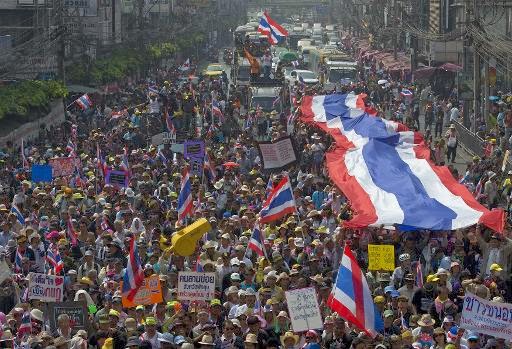 |
Thai
anti-government protesters carry a large national flag as they parade
during a
rally in Bangkok on January 25, 2014 (AFP/File, Pornchai Kittiwongsakul)
|
Washington
— Time was, overturning a freely-elected government would have earned a sharp
US rebuke. But as people power revolts sweep some countries, Washington is
increasingly giving its blessing to ousting leaders accused of betraying
democracy.
From Egypt,
where the nation's first democratically-elected president Islamist leader
Mohamed Morsi was toppled in July by the army, to Ukraine where Viktor
Yanukovych, brought to power in 2010 polls, fled his post after months of
street protests, the US has had to fine-tune its response.
Indeed US
Secretary of State John Kerry said bluntly this week: "A democracy is not
defined solely by an election."
"You
can have a democratically-elected government, but you don't have
democratically-instituted reforms that actually give you a democracy, a full,
practicing, functioning democracy," Kerry told reporters.
"And
what you have in many places is a general election, a popular election, absent
reform, present with great corruption, great cronyism and a huge distortion of
democratic process."
While at
first glance protests in Thailand and Venezuela may have nothing in common with
the demonstrations against the elected leaders in Ukraine and Egypt, analysts
and diplomats argue there is often a common core.
It is
"an incredible yearning for modernity, for change, for choice, for
empowerment of individuals that is moving across the world, and in many cases
moving a lot faster than political leadership is either aware of or able to
respond to," Kerry said.
-'People
must act'-
French
intellectual Jacques Attali, once an advisor to former president François
Mitterrand, asked "what are the people supposed to do when democracy has
been betrayed by those they brought to power?"
 |
People
stand on the awning outside the regional government building
in Kharkiv,
Ukraine, on March 1, 2014 (AFP, Sergey Bobok)
|
"The
people have to act, demonstrate, remind the leaders of their promises. And if
they don't succeed in convincing them, they have to bring them down,"
wrote Attali in his blog for the French magazine L'Express.
Despite
accusations from Venezuelan President Nicolas Maduro that the US is fomenting
unrest in his country, analysts see little direct involvement by Washington in
triggering revolts even if later on, such as in Ukraine, there is an open
eagerness to help the struggle towards democracy.
Top US
diplomat for Europe, Victoria Nuland, even visited the protestors on
Independence Square in Kiev in December to hand out bread in a high-profile
show of support for their desire to move closer to Europe and away from the
clutches of the communist authorities in Moscow, which since the end of the
Cold War has had difficult ties with the US.
"It is
accurate to say that where regimes violate human rights, move in that direction
or are involved in corruption, that those patterns of behavior are viewed
negatively by the US, the UK and other countries," said Mark Schneider,
senior vice president of the International Crisis Group.
"But I
think that it is rare that they move from that judgment to support in any way
violent activities. I think they are almost always somewhat surprised by the
depth, power, determination to accept sacrifice by people in certain
circumstances."
The
situation in Thailand, a constitutional monarchy since 1932 where the king is
highly revered, is somewhat unique.
Protestors
have been pressing for Prime Minister Yingluck Shinawatra to step aside in
favor of an unelected "people's council" to introduce vaguely defined
reforms such as tackling alleged corruption.
- A new
'class conflict'-
An
anti-corruption panel is now pressing negligence charges against Yingluck that
could lead to her removal from office and a five-year ban from politics.
 |
Demonstrators
stand next to car on fire during a protest against the
government of Venezuelan
President Nicolas Maduro in San Cristobal, capital
of the western border state
of Tachira, Venezuela, on February 22, 2014
(AFP/File, Luis Robayo)
|
But Paul
Chambers, director of research at the Institute of South East Asian Affairs at
Chiang Mai University, harked back to the radical philosophers of the early
20th century to draw parallels with a new "class conflict."
"Dominant
parties which continue to benefit from such (elite) systems are seen by mostly
middle and upper classes as impediments to freedom and facilitators of
corruption," argued Chambers, while lower classes have a more basic desire
for empowerment found just by casting a vote.
"These
clashing concepts of democracy and democratic legitimacy threatens to rapidly
destabilize the political essence of mostly young democracies, reducing nations
to potential civil war, a rebirth of tyranny and economic malaise," argued
Chambers.
Kerry
called late Friday for an investigation into "politically-motivated"
attacks which have left 23 people dead in Thailand, including four children,
but renewed assurances that Washington is not taking sides in the upheaval.
He had the
same message for Venezuela urging dialogue and revealing that the United States
is working with its allies in South America to find an acceptable third party
to help mediate an end to three weeks of often violent protests against
Maduro's lefist government.
"Unlike
in Ukraine, right now in Venezuela there is no an alternative power strong
enough to initiate regime change," said political professor Carlos Romero
from the Universidad Central de Venezuela.
He bemoaned
that so far there had been no international effort to end the violence, unlike
the diplomatic flurry around Ukraine and Egypt, an absence he attributed to his
country's lack of geopolitical significance.
Related Article:
No comments:
Post a Comment
Note: Only a member of this blog may post a comment.