Pages

Thursday, April 29, 2021

NRA chief draws fire for clumsy elephant hunt

MSN – AFP, 28 April 2021 

National Rifle Association chief Wayne LaPierre. (JOE RAEDLE)

Already facing legal problems, Wayne LaPierre, the head of the US National Rifle Association, is now facing ridicule for clumsily hunting an elephant in Botswana. 

Wayne LaPierre holding a sign: National Rifle Association chief Wayne LaPierre© JOE RAEDLE National Rifle Association chief Wayne LaPierre

Video of the 2013 hunt was published by The New Yorker and The Trace. 

It was taken for an NRA documentary but was never aired, The New Yorker said, "because of concerns that it could turn into a public-relations fiasco." 

In the video, LaPierre wounds an elephant with his first shot. 

He then shoots it three more times at point-blank range but hits it in the wrong place. 

A hunting guide finally fires the shot that dispatches the elephant. 

The footage also shows LaPierre's wife, Susan, killing an elephant, cutting off its tail and shouting "Victory!" 

Shannon Watts, founder of the gun control group Moms Demand Action, tweeted about the video. 

"CEO Wayne LaPierre manages to alienate both hunters and gun owners because not only is this inhumane, but he's a horrible shot," Watts said. 

Tanya Sanerib, international legal director at the Center for Biological Diversity, said it was "sickening to see LaPierre's brutal, clumsy slaughter of this beautiful creature. 

"No animal should suffer like this," Sanerib said in a statement. 

"Savannah elephants were just declared endangered by international experts, and these intelligent beings certainly shouldn't be used as paper targets by an inept marksman." 

The NRA filed for bankruptcy in Texas in January of this year after being sued by the New York state attorney general, who accused its leaders of misusing funds.

Thursday, April 22, 2021

Scandal-hit Greensill parent group enters liquidation

Yahoo – AFP, Roland JACKSON, 22 April 2021 

Administrators will wind down Greensill activities and attempt to sell off parts
of the business, which was founded in 2011 by Australian Lex Greensill

The Australian parent of failed specialist finance firm Greensill Capital, whose recent collapse sparked worldwide corporate fallout and a political scandal in Britain, has entered liquidation, administrators said Thursday. 

The demise of Greensill Capital Pty Ltd is the latest chapter in a saga that has ensnared Conservative politicians including ex-prime minister David Cameron. 

The company had filed for bankruptcy last month for its operations in Britain, and also in Australia where its parent group is based and Germany where it has a banking arm. 

Greensill's implosion threatens about 50,000 jobs at companies that relied on its supply chain financing, including the steel empire of Indian-British billionaire Sanjeev Gupta. 

Greensill Capital Pty Ltd, which is the parent company of the Global Greensill Group, had provided head office support and sourced funding for the finance giant's operations. 

Creditors including Credit Suisse, Japan's SoftBank and the Association of German Banks met online early Thursday and "resolved to place the company into liquidation", according to a statement from administrators Grant Thornton. 

The administrator provided an overview of the company to its 41 creditors and their representatives, who then voted in favour of liquidation. 

Administrators will now wind down activities and attempt to sell off chunks of the business, which was founded in 2011 by Australian Lex Greensill. 

"As of today, the company is now in liquidation," Grant Thornton added in the statement. 

"The liquidators will continue to identify and realise available assets, monitor developments in relation to the administrations of Greensill UK and the Greensill Bank AG, and continue their investigations in relation to Greensill Capital Pty Limited in liquidation." 

Cameron in firing line 

The controversial company specialised in short-term corporate loans via a complex business model that ultimately sparked its declaration of insolvency. 

Lex Greensill had obtained inside access to the Downing Street machine of then-premier Cameron, on the promise of helping to provide the government with the latest thinking on financial technology. 

Cameron was forced to step down following Britain's Brexit referendum in 2016, and two years later became an adviser to Greensill Capital, amassing share options that were potentially worth millions. 

This year, he privately lobbied senior officials including finance minister Rishi Sunak for government support before the firm's business model of supplying interim finance to companies imploded, rendering his share options worthless. 

Cameron is most directly in the firing line because of his personal and undeclared lobbying, but denies any impropriety. 

The Greensill scandal now faces heightened scrutiny in Britain, where the government already faces cronyism allegations over key contracts linked to its Covid-19 response. 

Parliament's Treasury Committee has launched an inquiry into Greensill's collapse, with appearances widely expected from Cameron, Sunak, and Lex Greensill. 

Greensill faces a string of other inquiries in Britain, with the National Audit Office also probing the firm's involvement in Covid-19 support schemes and state monitoring of its activities. 

Labour leader Keir Starmer slammed Prime Minister Boris Johnson on Wednesday over government "sleaze" involving preferential access given to both Greensill and pro-Brexit billionaire entrepreneur James Dyson.

Tuesday, April 20, 2021

Super League pits economics against history in a clash of cultures

Yahoo – AFP, Antoine MAIGNAN,  April 20, 2021 
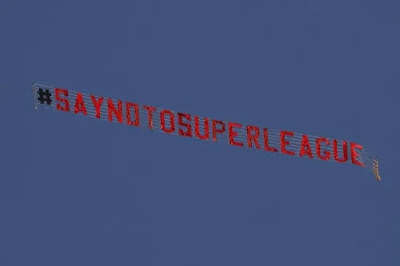
A plane flies above Elland Road in Leeds before the Premier League game
against Liverpool protesting against the planned Super League

As the clubs who want to form a Super League focus on their economic futures, they find themselves attacked on all sides for being at odds with football's past. 

"Created by the poor, stolen by the rich," read one banner held up by fans outside Manchester United's Old Trafford stadium on Monday. It summed up the frustration that has been gripping most football followers since the plans were announced. 

UEFA president Aleksander Ceferin said the proposed closed breakaway league was "a spit in the face" of "football lovers". 

"Everyone is united against this disgraceful, self-serving proposal, fuelled by greed above all else," he said. 

Despite the opposition of their own fans, national governments and the football authorities the 12 clubs are pressing ahead. 

They represent just seven cities in three countries. Six are from England and three each from Spain and Italy. 

The suspicion of fans that the clubs are losing touch with their roots is amplified by the foreign ownership of the majority of the rebel clubs, in several cases through faceless holding companies. 

Manchester City are owned by Sheikh Mansour, a member of the Abu Dhabi royal family. Inter Milan are controlled by Chinese holding company Suning. Chelsea are owned by Russian billionaire Roman Abramovic. 

'Americanisation of the world' 

But the greatest suspicion is that the proposed league is part of what French football historian Paul Dietschy called "the Americanisation of the world". 

An Arsenal fan hangs a banner aimed at the club's America
owner on their Emirates Stadium

Four, Liverpool, Manchester United, Arsenal and AC Milan, are owned by Americans or companies based in the United States. 

Of those, three own franchises in major US sports. 

The Fenway Sports Group at Liverpool also owns baseball's Boston Red Sox. The Glazer family at Manchester United own Super Bowl champions the Tampa Bay Buccaneers. Stan Kroenke, who controls Arsenal, also owns the Los Angeles Rams of the National Football League and the Denver Nuggets of the National Basketball Association. 

There is also an American influence at Juventus. The club has a long association with Fiat, now part of American-Italian group Stellantis. That company's American president John Elkann, a grandson of former Juventus owner Gianni Agnelli, appointed his cousin Andrea Agnelli to run the club. 

The proposed league is being underwritten by American money, in the form of a four billion dollar (3.32bn euro) loan from Wall Street bank JPMorgan Chase. 

As long ago as the 1950s and 1960s, research by American economists showed their clubs were "profit maximisers", while British economist Peter Sloane found that football clubs in the English league were "utility maximisers", motivated by non-financial considerations. 

"American sport has historically been very focused on profit," said Chris Winn, a researcher at the University Campus of Football Business, which has links with Manchester City as well as Premier League Burnley. 

"It's no coincidence that there is a core American group at the heart of these Super League proposals. The European football elite are looking for a guaranteed piece of the pie every year." 

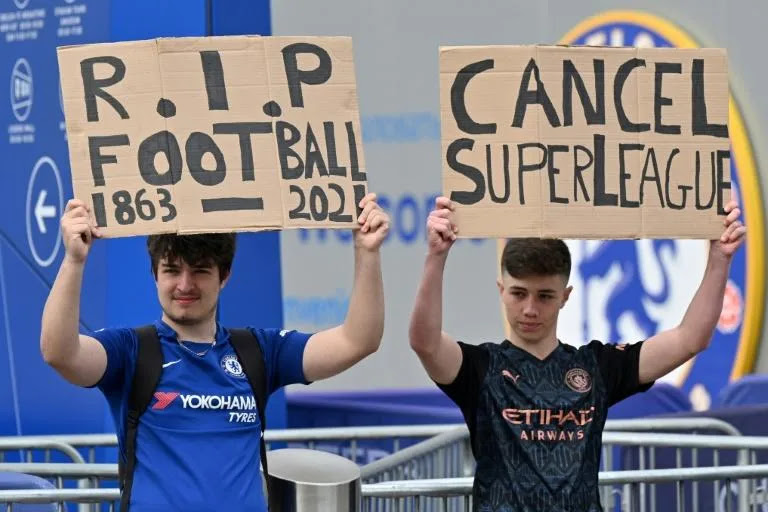
Chelsea fans protested outside Stamford Bridge on Tuesday


Dietschy told AFP that the clubs no longer wanted to be anchored in their local landscape. 

"These clubs are becoming brands and as they target other markets," he said. "It's counter-intuitive when you think of football, but it can work like the American franchises." 

'The rich stealing what the people created' 

But, Dietschy cautioned, "we must be wary of romanticism applied to football. The richest have always dominated. What has changed, however, is that today money is no longer used to win but to make a profit." 

Yet some elite players, who stand to share that profit, are outraged. 

"I believe in an improved Champions League, but not in the rich stealing what the people created," said Paris Saint-Germain's Spain midfielder Ander Herrera 

"The rich have stolen what the people have created," Manchester United's Portuguese player Bruno Fernandes posted on social media. "Dreams cannot be bought." 

So far the Super League has not attracted any clubs in the key market of Germany. 

Bayern Munich and Borussia Dortmund have both taken a public stand against the plan. 

"I would like to make it explicitly clear that FC Bayern will not be taking part in the Super League," said club chairman Karl-Heinz Rummenigge in a statement on Tuesday. 

Like Barcelona and Real Madrid, the two Bundesliga giants are fan owned, but German supporters have long been vocal defenders of football traditions. 

Bayern is run by German former players in contrast to the Super League clubs. 

"The directors of these clubs are people trained in top management schools, and their logic is that of business and profit," said Dietschy.